

Understanding the role of each drone component makes it easier to troubleshoot problems and choose the right parts for a specific build. Different types of drones can also require very different components. An FPV drone, for example, may use a battery with a high C-rating to provide the current needed for rapid acceleration, while a development-focused drone may prioritize battery capacity and efficiency instead.
In this article, I break down the purpose of the main components found in a drone build and explain some of the variations you may encounter. Keep in mind that these are general categories, and the specific components you need will depend on the type of drone you are building.
1. Frame
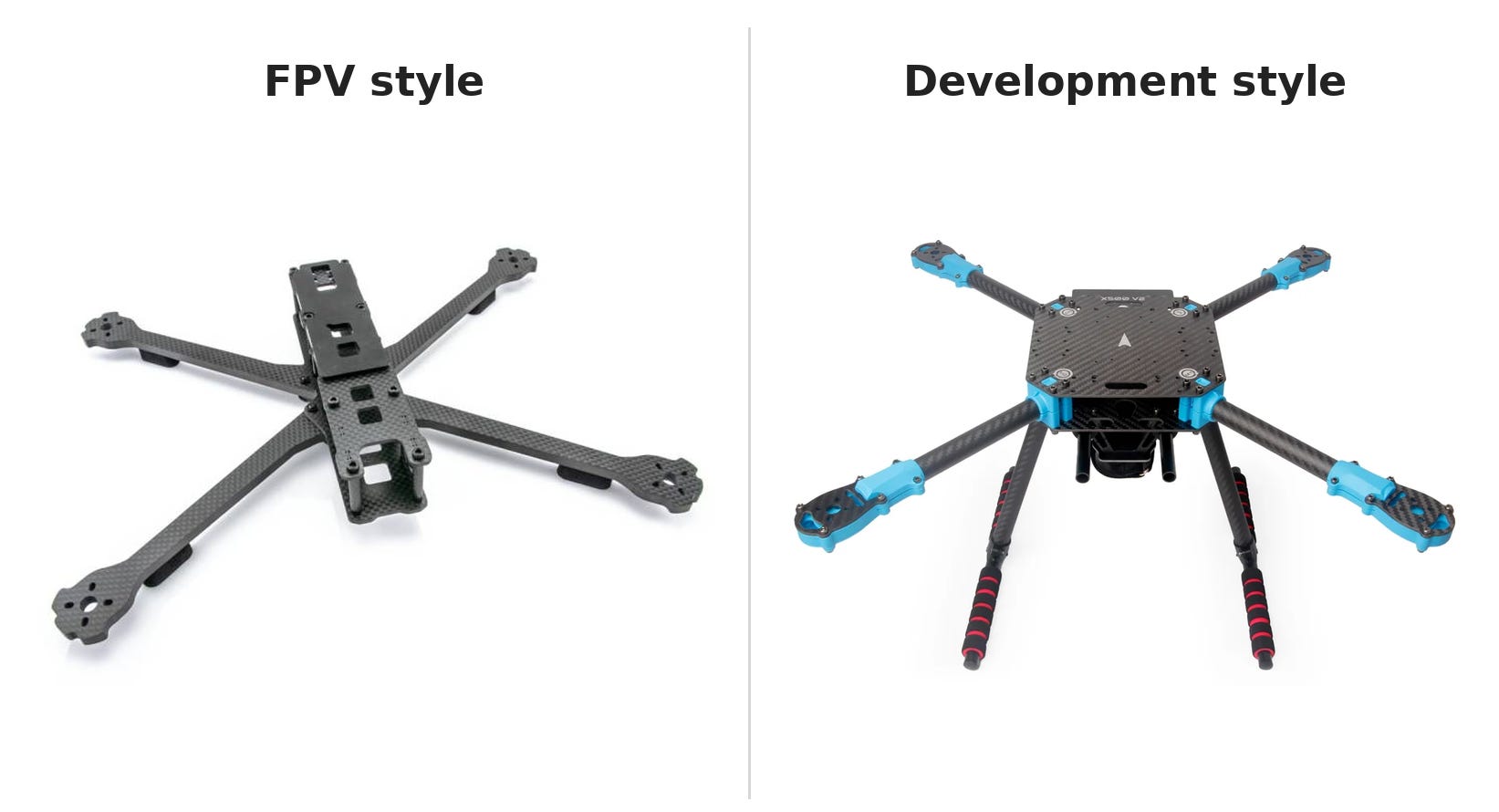
The frame provides the structure of the drone and gives the other components a place to mount. Frame design has a major effect on what hardware can be installed and how the drone behaves in flight.
Holds the motors, flight controller, battery, and other components in place
Determines the available mounting space for equipment and payloads
Helps determine which propeller sizes can be used
Smaller, lighter frames are common on agile FPV drones, while larger frames such as the X500 provide more room for batteries, sensors, cameras, and companion computers
Frame size does not determine propeller size by itself, but the two are closely related. A larger frame can generally accommodate larger propellers, while the motor and power system must also be capable of turning those propellers efficiently.
2. Propulsion System
The propulsion system is responsible for producing the thrust that keeps the drone in the air and allows it to move. The motors, propellers, and ESCs have to work together, so changing one often requires changes to the others.
Motors
Motors convert electrical energy into mechanical rotation that spins the propellers. On a typical multirotor, the flight controller constantly changes the speed of individual motors to control the aircraft’s movement.
Spin the propellers to produce thrust
Increase or decrease speed independently to control the drone’s attitude and movement
Usually installed in alternating clockwise and counter-clockwise directions so that the drone’s rotational forces balance each other
Need to be matched with the propellers, battery voltage, and ESCs being used
A motor spinning faster produces more thrust, while changing the relative speed between motors allows the flight controller to control roll, pitch, and yaw.
Propellers
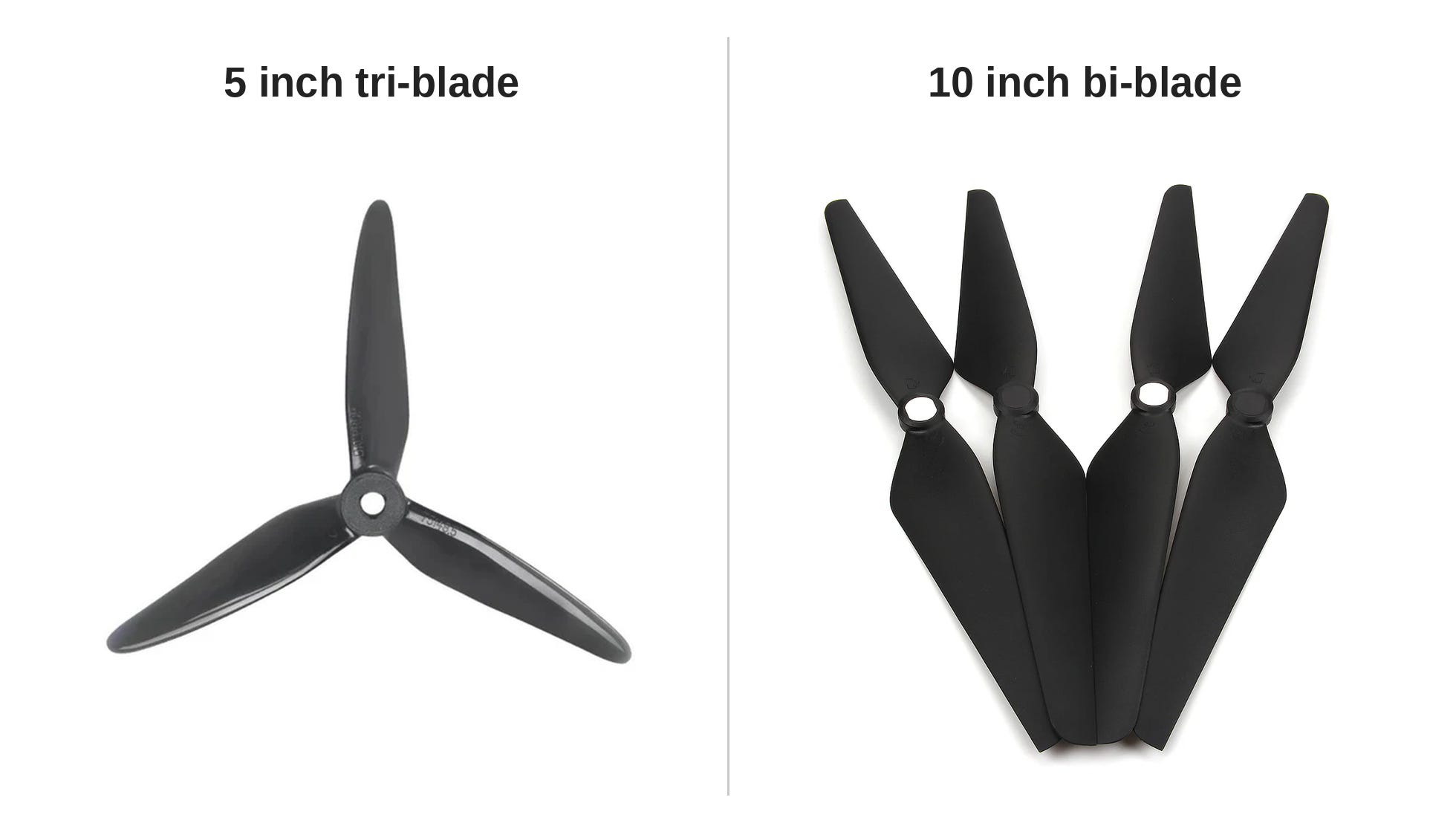
Propellers convert the motor’s rotation into thrust. Their diameter, pitch, and design have a major effect on how efficiently the drone produces lift.
Larger propellers can generally produce more thrust and can be efficient for lifting heavier aircraft
Smaller propellers tend to be easier to accelerate and are common on lightweight, agile drones
Higher-pitch propellers can increase the amount of air moved per revolution but also require more torque and power
Propellers must be selected to match the motors and the rest of the power system
Because propellers affect motor load, motors, propellers, and ESCs should be treated as a system rather than selected independently.
ESCs (Electronic Speed Controllers)
The ESC sits between the power system and the motor. It receives commands from the flight controller and controls how much electrical power is delivered to the motor.
Controls the speed of an individual motor
Converts the flight controller’s motor command into electrical switching that drives the motor
Must be rated for the motor, battery voltage, and expected current
Can use different communication protocols, such as PWM, OneShot, or DShot
The specific protocol depends on the flight controller and ESCs. PX4, for example, supports several ESC protocols, including PWM, OneShot, DShot, and DroneCAN. DShot is a digital protocol that also avoids the traditional throttle calibration required by PWM-based ESCs.
Motor Control Signal
The flight controller needs a way to communicate the desired motor output to each ESC. This is not a separate physical component, but rather the communication link between the flight controller and ESC.
Common protocols include PWM, OneShot, and DShot. The choice depends on the hardware and flight-control software being used.
3. Power System
The power system supplies electricity to the motors, flight controller, and other electronics. Choosing the correct battery and power hardware is especially important because the electrical requirements of the propulsion system can vary significantly between drones.
Battery
The battery stores the electrical energy used by the drone. LiPo batteries are commonly used in RC aircraft because they provide a high amount of power while remaining relatively lightweight.
Three battery specifications are especially important when choosing a battery:
Capacity (mAh): Measured in milliamp-hours, this indicates how much electrical charge the battery can store. A higher-capacity battery can generally provide more energy, but it is also heavier, so there is a tradeoff between flight time and weight.
C-rating: The C-rating represents how much current a battery is designed to deliver relative to its capacity. A rough way to calculate the rated maximum discharge current is to multiply the battery’s capacity in amp-hours by its C-rating. For example, a 5 Ah battery rated at 40C would have a theoretical rating of 200 A. Actual performance depends on the battery and its manufacturer.
Cell count (S): The S-rating describes how many individual LiPo cells are connected in series. More cells increase the pack’s voltage. For example, a 4S LiPo has four cells connected in series and a nominal voltage of about 14.8 V.
A higher C-rating is not automatically better. The battery should be chosen based on the current required by the motors and the rest of the electrical system, while also considering its weight and capacity.
Charger
A charger replenishes the battery’s energy after a flight. LiPo batteries require chargers designed for lithium-polymer batteries, and multi-cell packs are normally charged using a balance connection so that the individual cells remain at the correct voltage relative to one another.
The charger must be configured for the battery’s cell count and charging requirements. Using the wrong settings can damage the battery.
Power Module
The power module connects the battery’s electrical system to the flight controller. It provides regulated power for the flight controller and can measure battery voltage and current.
This information is sent to the flight controller so the software can estimate how much battery capacity remains and trigger low-battery warnings or other failsafes. It is therefore more accurate to think of the power module as providing the measurements used to estimate remaining battery capacity rather than directly measuring a simple “battery percentage.”
Power Distribution Board (PDB)
A power distribution board takes the battery’s main power connection and distributes it to the components that need it, particularly the ESCs and motors.
Splits the battery connection into multiple power outputs
Helps simplify the drone’s wiring
Some PDBs also include additional power regulation or battery-monitoring circuitry
Not every modern drone needs a separate PDB. Some systems combine power distribution with other electronics, while certain flight controllers or ESC setups have different power architectures.
4. Flight Control & Navigation
Flight Controller
The flight controller is the central computer responsible for stabilizing and controlling the drone. It receives information from sensors and other systems, determines what the aircraft needs to do, and sends commands to the motors.
Processes sensor data to determine the drone’s orientation and movement
Controls the motors through the ESCs
Connects to peripherals such as GPS receivers, radio receivers, telemetry radios, and companion computers
Different flight controllers have different processors, sensor configurations, memory, and numbers and types of ports
The flight controller is the part that ties the rest of the system together. Even though the motors provide the thrust, the flight controller determines how that thrust is distributed to keep the drone stable and make it move as commanded.
GPS Module
A GPS module provides the flight controller with information about the drone’s position and movement. GPS is especially useful for drones that need navigation features beyond basic manual stabilization.
Provides position information
Enables features such as GPS-assisted position hold
Can be used for waypoint missions and other autonomous navigation features
Provides important information for features such as GPS-based return-to-home
GPS is not necessary for every type of drone. Many small FPV drones, for example, can fly without it, while autonomous and development-focused platforms often benefit greatly from having a GPS module.
5. Communication Systems
Drones commonly have multiple communication links. One connects the pilot to the aircraft, while another can connect the flight controller to a ground station or computer.
Transmitter and Receiver
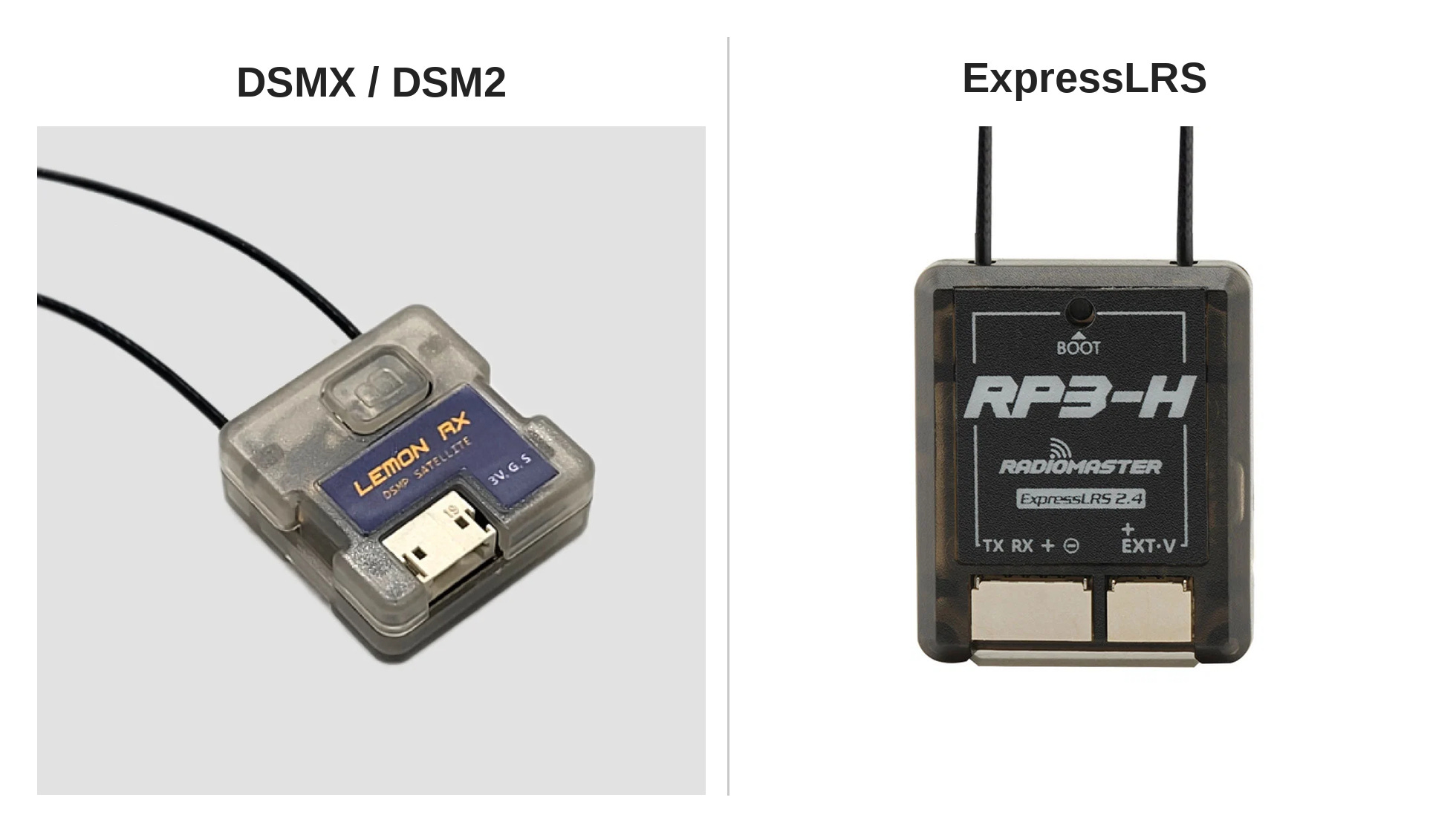
The transmitter is the controller used by the pilot to send commands to the drone. The receiver is installed on the drone and passes those commands to the flight controller.
The exact protocols used depend on the equipment. For example, ExpressLRS is a radio-control system, while an ExpressLRS receiver commonly communicates with the flight controller over the CRSF serial protocol. Other receivers may use protocols such as SBUS.
When selecting a transmitter and receiver, make sure they are compatible with each other and that the receiver can communicate with your flight controller using a supported protocol.
Telemetry Radio
A telemetry radio provides a separate wireless connection between the drone and a ground station.
Instead of carrying the pilot’s stick commands, this link can be used to send information such as flight status, position, battery data, and other telemetry between the aircraft and a computer. It can also allow a ground station to send commands to the flight controller.
This type of connection is particularly useful for development and autonomous drones because it allows you to monitor and interact with the vehicle from a computer without requiring the computer itself to be mounted on the drone.
If you would like to read more about using code to fly a drone, you can read about it here: Testing Autonomous Drone Movement with PX4 Python Scripts.
6. Regulatory Compliance
Remote ID Broadcast Module
Remote ID is a regulatory requirement that applies to many drones in the United States. Rather than being a flight component, a Remote ID module is part of the system used to meet FAA identification requdddddddirements.
A Remote ID broadcast module broadcasts identification and location information while the drone is flying. The FAA describes it as a way for other parties to receive information about the drone and, depending on the type of Remote ID system, the control station or takeoff location.
In the United States, drones that are required to be registered or are registered generally must comply with Remote ID. There are different ways to comply, including using a Standard Remote ID drone, attaching an approved broadcast module, or operating within an FAA-Recognized Identification Area (FRIA) when the applicable requirements are met.
Because drone regulations can change and may differ by location and type of operation, always check the current rules before flying.
Here Are the Parts I Used
The following are the main components I used for my development-focused drone build:
Frame: Holybro X500 V2 ARF Kit
Battery: Tattu 5200mAh 14.8V 35C 4S
Flight controller: Holybro Pixhawk 6C
Power module: Holybro PM02 V3
Battery: Tattu 5200mAh 14.8V 35C 4S LiPo
GPS: Holybro M10 GPS
Transmitter: RadioMaster Boxer
Telemetry radio: Holybro SiK Telemetry Radio V3
Remote ID module: Holy Stone Remote ID Broadcast Module